The Best Wood for a Pizza Oven, and What You Should Never Burn
Ask five people what the best wood for a pizza oven is and you will get five species and a lot of confidence.
The honest answer is that species is the second question. The first one is how dry the wood is, and getting that wrong will beat any amount of careful oak-versus-beech deliberation.
Here is what actually matters, in the order it matters.
Moisture beats species, every time
Water in wood has to boil off before the wood can burn properly, and that energy comes out of your oven temperature. The US EPA puts the threshold at under 20 percent moisture, which is the number worth remembering.
Above that line you get the same miserable pattern regardless of species: long preheats, smoke pouring out of the mouth instead of a clean flame licking the dome, and a fire that sulks every time you add a log. Soot builds on the inside of the arch where it has no business being, and it does not come off easily.
Dry mid-grade hardwood outperforms wet premium oak. That is the whole lesson, and it is why the firewood conversation online so often talks past itself.
How to tell whether yours is actually dry
Sellers describe wood as seasoned with some generosity, so it is worth checking rather than trusting.
A moisture meter is about the price of a couple of bags of wood and removes the argument entirely. Split a piece first and test the freshly exposed inner face, because the outside of a log dries long before the middle does and testing the surface flatters it.
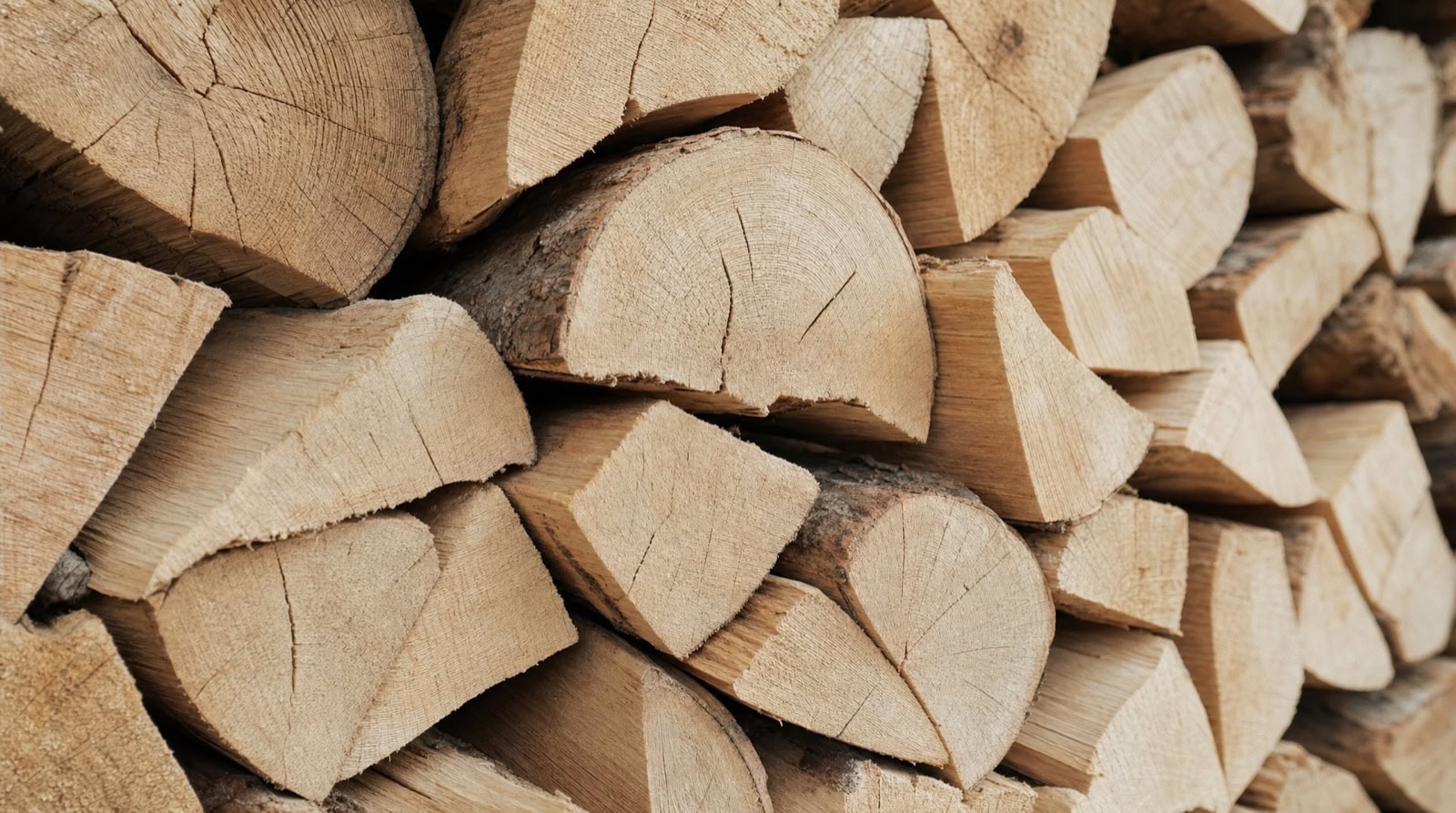
Without a meter, three rough signals. Dry wood feels lighter than it looks. Two pieces knocked together ring rather than thud. And the cut end usually shows fine cracks radiating out from the center, which appear as the wood shrinks while it dries.
If you are seasoning your own, the EPA guidance is to season wood for at least six months, stacked off the ground with only the top covered. Covering the sides traps moisture in, which is the most common way people accidentally keep their firewood wet.
The best wood for a pizza oven, by species
Once the wood is dry, species is a real but secondary choice. Dense hardwoods hold a coal bed, and a coal bed is what lets you cook a second and third pizza without rebuilding the fire from scratch each time. Lighter woods burn bright and disappear, which is fine for the first pie and frustrating by the fourth.
| Wood | Why people choose it | Worth knowing |
|---|---|---|
| Oak | Dense, long burn, strong coal bed, neutral smoke | The default for good reason. Slower to get going from cold. |
| Beech | Burns hot and clean, lights readily | Very close to oak in practice; often cheaper depending on region. |
| Maple | Steady heat, tidy burn | A good all-rounder if oak is expensive where you are. |
| Ash | Lights easily, burns clean | Forgiving for beginners. Coal bed is lighter than oak. |
| Birch | Fast, bright flame | Burns through quickly. Better mixed with something denser. |
| Fruit woods | Cherry, apple; faint sweetness | Pleasant, usually pricier, and the effect is subtle at pizza speeds. |
Mixing is fine, and common: something quick-lighting to establish the fire, oak to sustain it.
What never goes in the oven
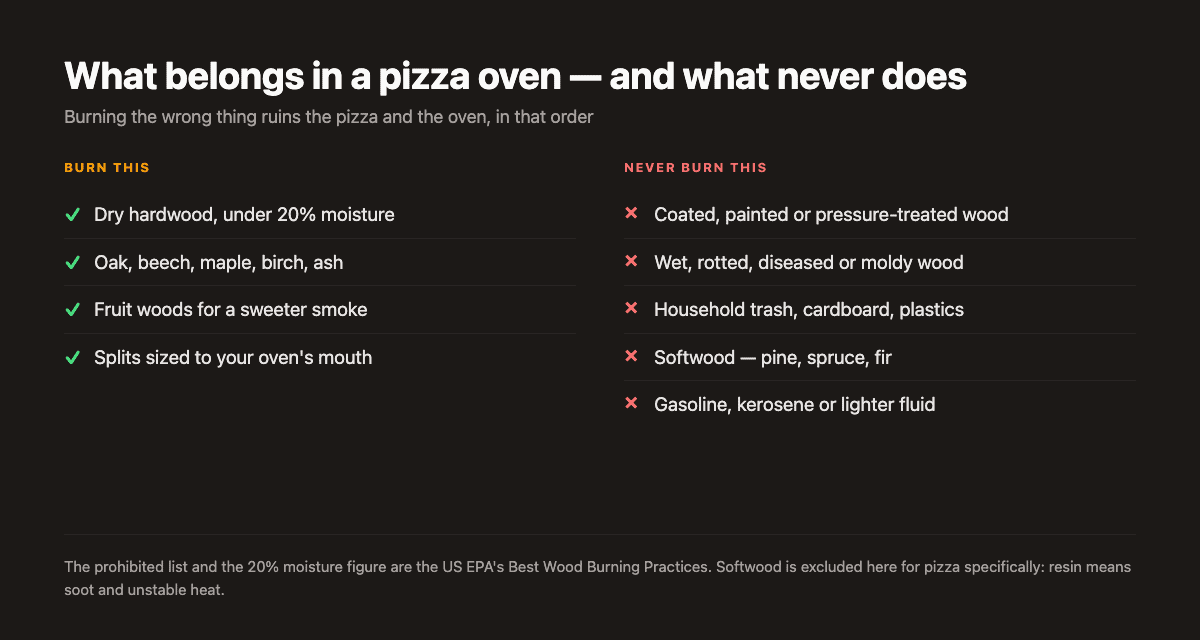
This part is not a matter of taste. The EPA’s list of things never to burn includes coated, painted and pressure-treated wood, household trash including cardboard and plastics, and wet, rotted, diseased or moldy wood. It also says never to start a fire with gasoline, kerosene or charcoal starter.
Treated wood is the one that catches people out, usually as offcuts from a decking project sitting conveniently near the oven. The preservatives do not burn away harmlessly, and the food is inches from the flame.
Softwood is the pizza-specific addition to that list. Pine, spruce and fir are fine in a fire pit and wrong in an oven, for the resin reasons above.
Size, and why your oven decides it
A log that fits your fireplace will not fit most pizza ovens.
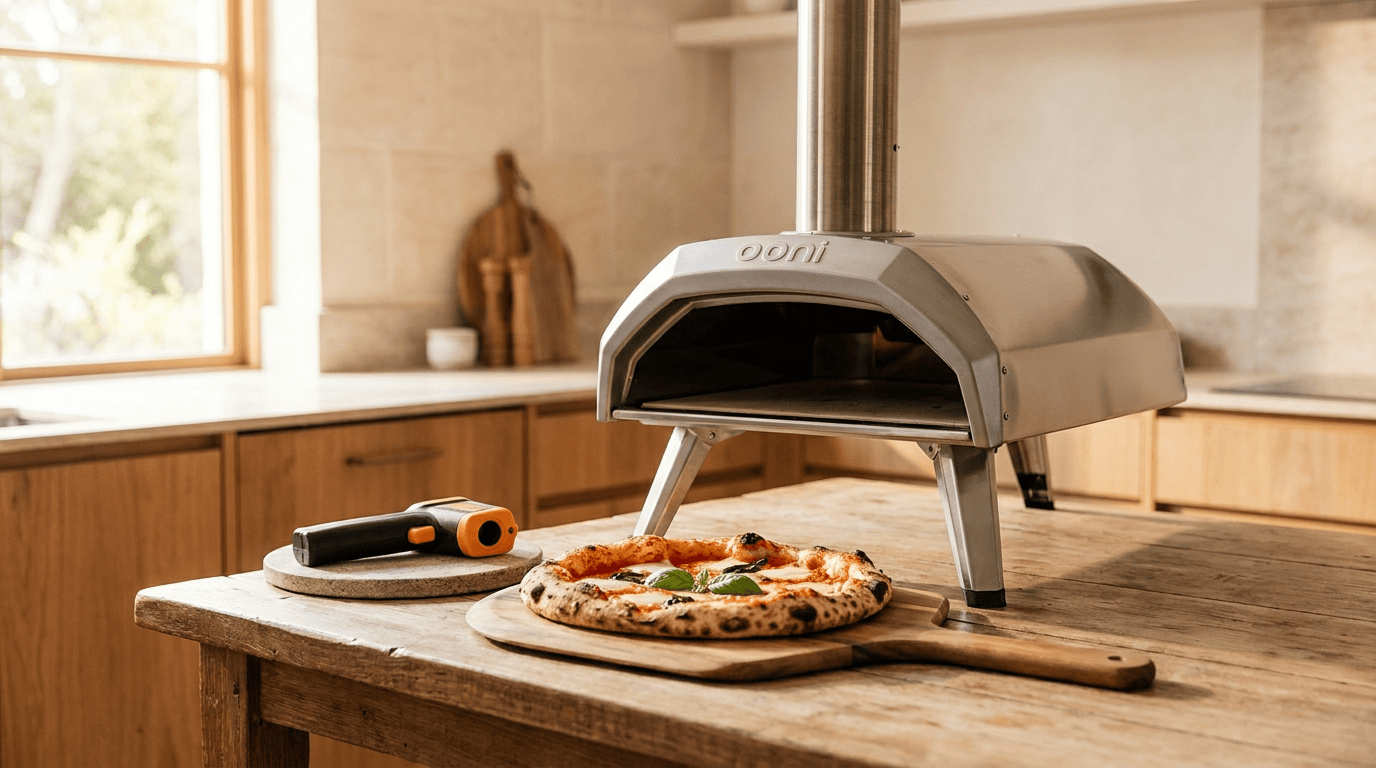
Compact ovens want small splits, and the mouth of your particular oven sets the limit rather than any universal figure. Check the manual for the model you own, since manufacturers such as Ooni and others publish a recommended split size for each oven, and a piece an inch too long simply will not sit right against the wall where the fire belongs.
Smaller splits also light faster and give finer control over the flame, which matters far more in a small oven than in a large masonry one. If you are still deciding between oven types, our comparison of brick and wood-fired ovens covers how much thermal mass changes the fuel you need.
Storing it so it stays dry
Wood that arrives dry does not stay dry on its own.
The stacking rule in the EPA guidance is the part people get backwards: off the ground, top covered, sides open. A tarp wrapped around the whole pile looks tidier and does the opposite of what you want, sealing moisture in and letting the stack sweat. Air has to move through it.
For a small oven, keeping a week or two of wood somewhere genuinely indoors, a garage or a shed, and topping it up from the outdoor stack is the easiest way to guarantee what you burn is at its driest. Wood picked up straight off a damp stack in November will behave noticeably worse than the same wood after a few days inside.
How much you will actually get through
Less than most people expect, and more than the first-timers who buy one small bag anticipate.
A compact oven brought up to temperature and held there for an evening of pizzas runs through a surprising amount of small splits, because small splits burn fast by design. The fire is doing two jobs at once: holding the dome hot and maintaining a live flame across the ceiling. Both stop the moment you stop feeding it.
Plan on having more than you think you need for a first session, then measure your own usage rather than trusting a number from a blog. Ovens, weather and how long you keep cooking vary too much for a single figure to be honest. Once you know your own rate, buying in bulk becomes the obvious saving.
Buying it without overpaying
Kiln-dried wood sold in pizza-sized splits costs noticeably more per pound than a general firewood delivery, and for a small oven used a few times a month that premium is usually worth it. You are paying for a known moisture content and a size that fits, and you are not giving up a corner of the garden to a cord of wood for six months. For occasional use that is a fair trade, and it removes the single biggest variable from your cooking.
Buying in volume changes the maths completely.
If you burn regularly and have somewhere dry to keep it, ordinary hardwood seasoned yourself will cost a fraction as much per pizza. The trade is time and space rather than money, which is exactly the trade a lot of people would rather make once they know their own usage.
Some links on this page are affiliate links, which means we may earn a small commission if you buy through them at no extra cost to you. That commission never influences which products we recommend or how we rank them.
Frequently Asked Questions
What is the best wood for a pizza oven?
Dry hardwood. Oak is the usual default because it burns hot and leaves a dense coal bed that holds heat between pizzas, with beech, maple, birch and ash all working well. Species matters less than dryness though. Wet oak will disappoint you where dry maple will not.
Can I use kiln-dried wood instead of seasoned?
Yes, and it is generally the easier option. Kiln-dried wood is sold at a known low moisture content, so you skip the guesswork and the storage. Properly seasoned wood reaches the same place for less money if you have somewhere dry to keep it for six months or more.
Why can I not burn pine in a pizza oven?
Resin. Softwoods like pine, spruce and fir carry resin that burns sooty and unevenly, which coats the dome and puts an acrid note into food cooking a few inches above the flame. It also spits. None of that matters in a fire pit, but a pizza oven is a small enclosed space and the food is right there.
How do I know if my wood is dry enough?
Buy a moisture meter, split a piece and test the fresh inner face rather than the outside. Failing that, dry wood is lighter than it looks, sounds sharp rather than dull when two pieces are knocked together, and usually shows small cracks radiating from the center of the cut end.
Does the type of wood change how the pizza tastes?
Less than most people hope. At pizza temperatures a pie is in the oven for a couple of minutes, which is not long enough to take on much smoke character. Fruit woods can add a faint sweetness, but if a pizza tastes strongly of smoke that is usually a sign the fire is starving rather than a feature of the species.
The short version
Buy dry hardwood, split small enough for your oven, and stop worrying about the species chart. Oak if it is available and affordable, anything dense and dry if it is not.
If your pizzas are coming out pale or your oven is smoking, check the wood before you change anything else. It is the cheapest variable to fix and the one most likely to be the problem. Our guide to fixing uneven heat covers what to look at once you have ruled the fuel out.
Last reviewed September 9, 2026 by Heather Smith.